
Snake Puzzle Games: How They Work, How to Solve Them
Take the clock out of Snake and it becomes a question of order. Here is how the genre works and how to get unstuck.
A snake puzzle game keeps the snake and the apples and drops the reflexes. You move one cell per press, the level has a solution, and losing means you picked the wrong order.
Four families
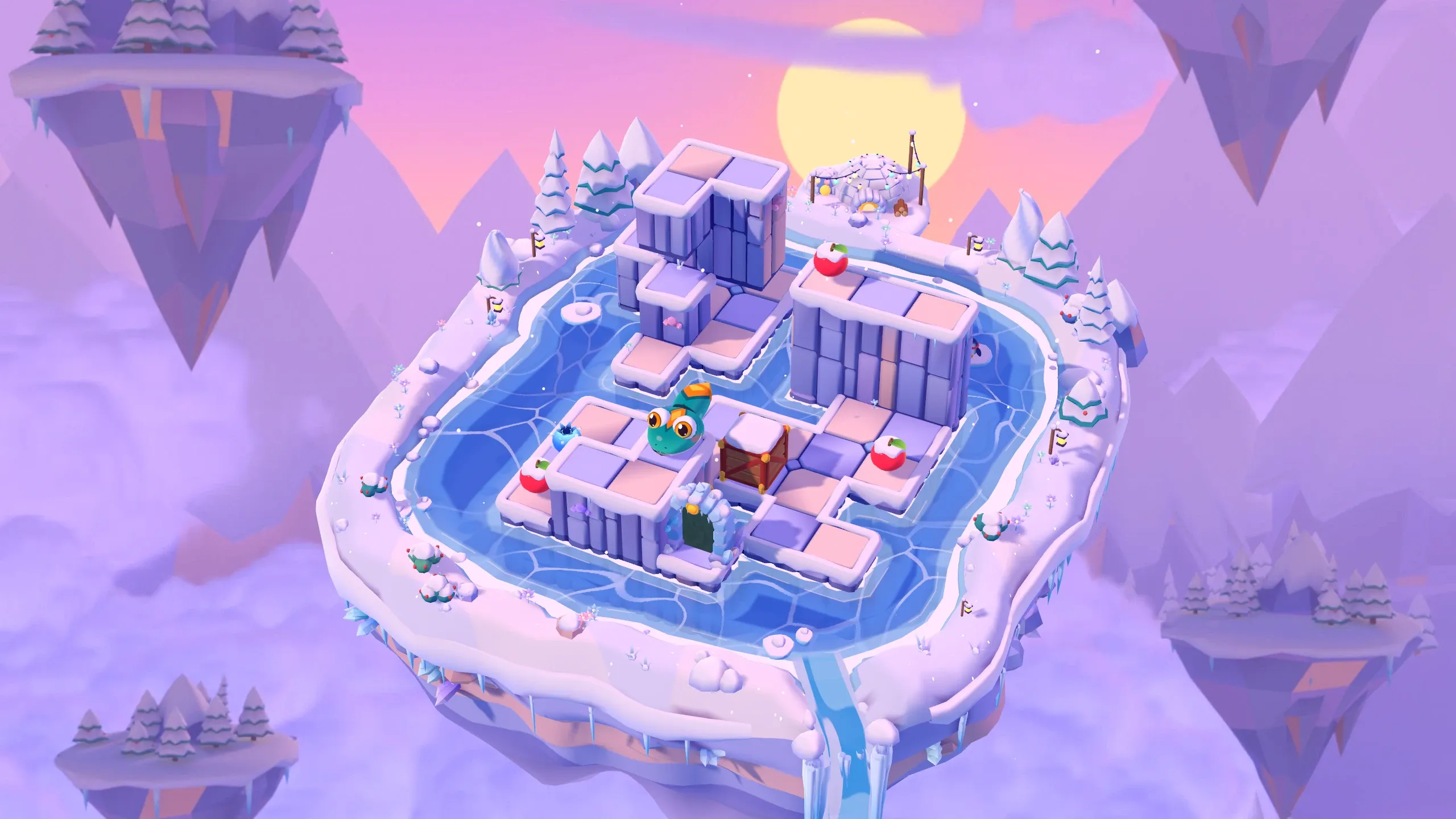
Route puzzles ask you to cover a board without crossing yourself. Gravity puzzles, such as Apple Worm, add falling, so your length becomes a support. Pushing puzzles borrow crates from warehouse games. 3D puzzles combine the last two on a board with height; that is where Snakadia sits.
How long is a good level?
Shorter than it feels. These are the best solutions we found for our own hundred boards:
| World | Shortest | Average | Longest |
|---|---|---|---|
| Sunny Garden | 14 moves | 30 moves | 43 moves |
| Frozen Peaks | 25 moves | 34 moves | 52 moves |
| Glowing Forest | 15 moves | 27 moves | 40 moves |
| Dragon Volcano | 31 moves | 42 moves | 60 moves |
The third world is the shortest on average and not the easiest. Once the body carries current, a level needs fewer steps but each has to land in the right place. Counting moves tells you how much walking there is, and little about the thinking.
Solving from the exit
Try this on any board, ours or someone else’s:
- Stand at the exit in your head. Which cells can you arrive from? Usually one or two.
- How long must the snake be to make that last approach? Subtract your starting length. That is the number of apples you need before it.
- Mark everything that works only once: cracked tiles, crates that can fall in water, one-way arches. Each has to be saved for the step that has no other way.
- Now play forward and stop at the first once-only object. If using it there leaves a later step without support, the order is wrong.
Parity, the quiet trick
Colour the floor like a chessboard. Every move changes the colour under your head. So if the gap from one spot to another is an even number of steps, you can’t waste exactly one move and arrive on the same cell. When you always reach a plate one step too early or too late, look for a detour of two, never of one.
When you are stuck
Undo back to the last push. Pushing a crate is the decision, and the crawling after it is transport. If that fails, rotate the view. A cell hidden behind a wall is the most common thing people miss on a 3D board.
For the version with a clock, there is Snake 3D in the browser, and a guide to filling its board.